
8 Sex Positions for Limited Mobility That Actually Work
Sex positions for limited mobility that deliver real pleasure — adaptive missionary, spooning, cowgirl, lotus and more with pillow support and pacing tips.

Quick Facts
- What It Is: A practical guide to sex positions for limited mobility — adapted techniques for chronic pain, wheelchair users, arthritis, spinal cord injury, and fatigue
- Also Known As: Adaptive sex positions, disability-friendly positions, accessible intimacy techniques, mobility-friendly positions
- Difficulty: Easy to moderate (fully adjustable to your specific needs — no gymnastics required)
- Best For: Anyone with limited mobility, chronic pain, fatigue, arthritis, spinal cord injury, or partners with disabilities who want satisfying intimacy without physical strain
- Common Challenge: Finding positions that work with your specific condition, mobility aid, or pain pattern without sacrificing sensation
- Core Tools: Positioning wedges, firm support pillows, easy-grip vibrators, wearable stimulators, remote-controlled toys
Why Sex Positions for Limited Mobility Work With Your Body
Sex positions for limited mobility share one mechanical principle: they redistribute weight and movement to reduce strain on painful or less-mobile joints while maintaining or improving genital alignment. In practice, this means using external support — pillows, wedges, furniture, mobility aids — to hold the body at useful angles so muscles do not have to. The positions below apply that principle across different mobility profiles: wheelchair use, chronic pain, arthritis, fatigue, and upper or lower body restrictions.
Building Your Accessible Intimacy Foundation
Before exploring specific positions, two practical inputs shape everything else.
Communication as Direction, Not Medical Disclosure
Effective in-the-moment communication sounds like positioning direction, not a medical consultation. Before intimacy: "Tonight I want positions where you control the movement while I tell you the angle." During: "Support my hip right there." After: "That worked — your lower-body support made the depth much more consistent."
Research published in the Journal of Family Psychology demonstrates that open sexual communication significantly improves both relationship satisfaction and sexual function. Practical direction, delivered as part of the encounter rather than before or after it, carries the same benefit without the interruption.
Strategic Support and Pacing
Pillow placement that changes alignment:
- Hip elevation: 6–8 cm raises the pelvis to shift penetration angle toward the anterior vaginal wall without any active muscle effort from the person lying down
- Lower back support: A small lumbar pillow reduces the spinal extension that many missionary variants create
- Knee and joint cushioning: A folded pillow between the knees in side-lying positions prevents hip rotation that strains the SI joint
Pacing: Plan sessions in 10–15 minute active intervals with intentional rest pauses. Fatigue-driven compensation (gripping harder, bracing with a painful joint) causes more post-session soreness than the position itself. Moving between active and passive roles — one partner thrusting for a period, then stopping while the other grinds — extends sessions without accumulating strain.
Mobility aids as equipment: A locked wheelchair, rollator, or sturdy bed frame provides resistance-free anchor points for leverage. They are positioning tools, not obstacles.
8 Sex Positions for Limited Mobility
1. Adaptive Missionary
Adaptive Missionary keeps the face-to-face intimacy of standard missionary while removing the need for the receiving partner to hold any position actively. The receiving partner lies back with a wedge or two firm pillows under the hips — enough elevation to tilt the pelvis and angle the vaginal canal toward the partner above. The penetrating partner supports their upper body on forearms, keeping their weight off the receiving partner's torso and allowing breathing room.
Hip elevation in this range consistently shifts penetration to target the anterior vaginal wall, which is why the position feels different from flat missionary rather than simply more comfortable.
Setting up:
- One wedge or stacked firm pillows under the hips (roughly 15–20 cm total)
- Partner supports weight on forearms rather than hands to reduce wrist strain
- Keep a mobility aid within reach if the receiving partner may need to reposition
Adapting for specific conditions:
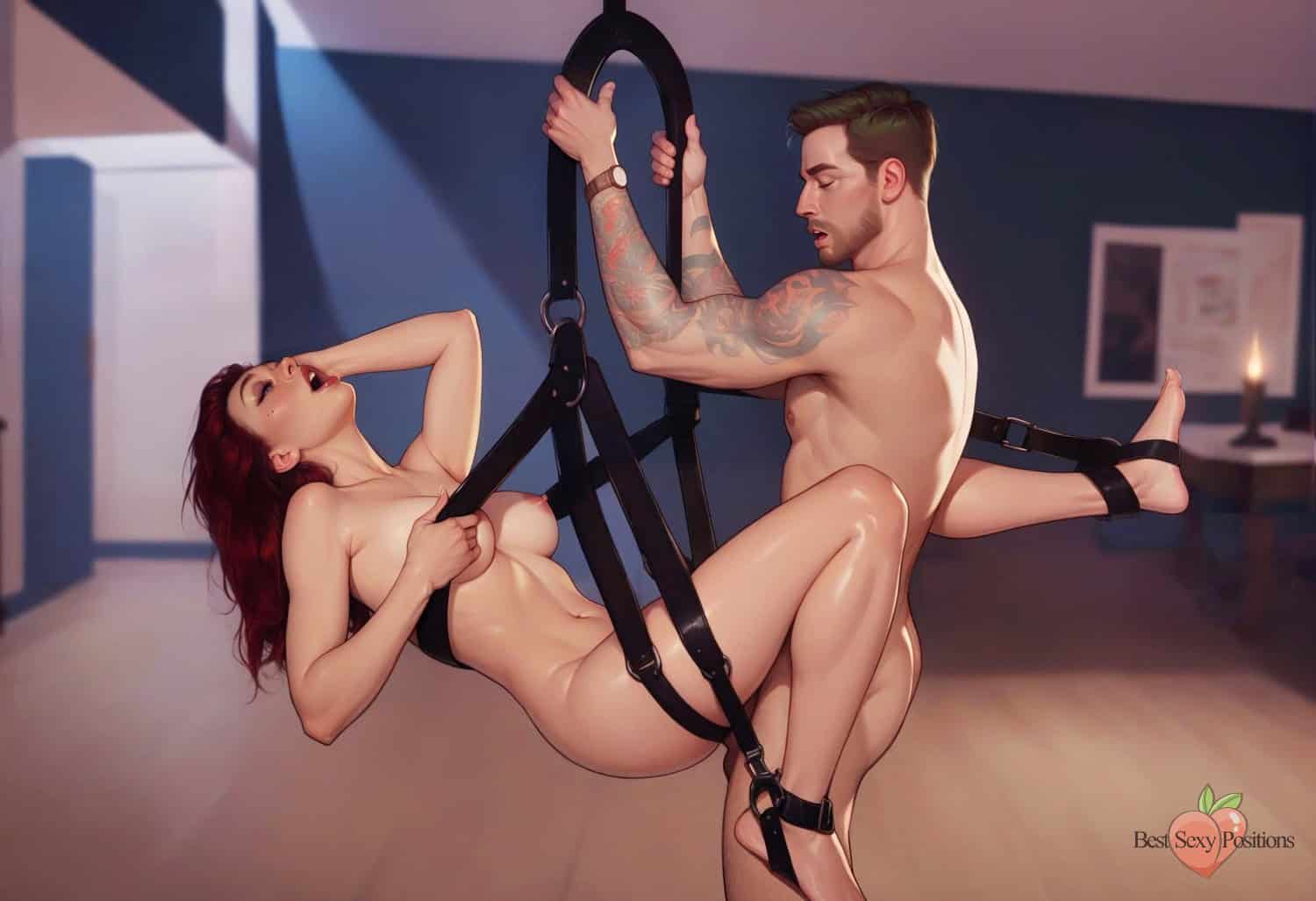
- Wheelchair users: The transfer to bed can be practiced until it flows as part of setup rather than interruption
- Chronic pain: Additional pillows under knees, thighs, or small of back reduce the number of body parts requiring active support
- Limited lower-body mobility: The receiving partner directs depth verbally; the penetrating partner controls all thrust
See the full technique guide for Classic Missionary.
2. Edge of Bed Butterfly

Edge of Bed Butterfly is a standing-entry variant where the receiving partner lies on their back at the mattress edge, hips at or just past the edge, legs resting on the penetrating partner's hips or shoulders. The standing partner controls all thrust from a mechanically strong upright position, taking hip flexion and extension out of the equation for the person lying down entirely.
Bed height determines alignment: 55–60 cm (22–24 inches) places the average adult's genitals at standing-partner hip height without either person compensating through posture. An adjustable-height bed or a platform addition solves mismatches.
Why this works well for limited mobility:
- The receiving partner bears no weight and performs no active movement unless they choose to
- Transfers from a wheelchair to the bed edge are shorter and simpler than full bed transfers
- The penetrating partner's standing posture provides natural core stability without equipment
The angle created by legs elevated on the partner's torso shortens the vaginal canal slightly and increases perceived depth — the same mechanism as the Butterfly position's reputation for sensation intensity. See the full Butterfly position guide.
3. Spooning

Spooning is the most universally accessible position in this roundup because both partners are fully supported by the mattress throughout. The receiving partner lies on their side with the penetrating partner curving behind them, entering from behind. Neither partner bears the other's weight at any point.
The mechanics: side-lying entry reduces vaginal depth slightly compared to rear-entry on all fours, which many people with pain prefer because it prevents the involuntary tensing that can occur when depth is unexpectedly intense. The penetrating partner's anterior reach also creates access to the clitoris or perineum during penetration without requiring a position change.
Building the support setup:
- Body pillow in front of the receiving partner supports the top arm and prevents the body from rolling forward
- Small pillow between the knees prevents the top hip from rotating inward and compressing the SI joint
- The lower leg can be straight or slightly bent — bent is typically more comfortable for hip arthritis
Pacing advantage: Because neither partner is bearing weight, this position can be sustained for extended periods — 20–30 minutes is common — before fatigue forces a transition. This makes it useful both for longer sessions and as a recovery position mid-encounter.
Adapting for specific conditions:
- Fibromyalgia and chronic fatigue: The full lateral support means no body part is holding itself up; the partner controls all movement while the receiving partner directs speed and depth verbally
- Hip replacement or arthritis: Avoid excessive inward rotation of the top hip; a thicker knee pillow maintains a more neutral hip angle
See the full Spooning position guide.
For more side-lying options suited to low-effort intimacy, see comfortable side sex positions and lazy sex positions.
4. Accessible Cowgirl and Reverse Cowgirl

Cowgirl positions give the person on top complete authority over depth, angle, and rhythm — which is significant when a pre-agreed position suddenly becomes uncomfortable and you need to adjust immediately without negotiating movement with a partner above or behind you. In terms of joint loading, Cowgirl distributes the active partner's weight through the knees and inner thighs rather than the hips, which makes it more accessible than it looks for some hip conditions.
The receiving-on-top partner controls pacing directly: grinding circles create sustained clitoral and anterior-wall friction without the vertical loading of bouncing. For limited upper-body strength, leaning forward onto the partner's chest shifts weight from the knees to the arms and reduces the range of motion required.
Setup for limited-mobility use:
- Headboard within reach gives the on-top partner a stable pull point for repositioning without putting strain on the partner below
- A small pillow under the lying partner's hips adjusts the entry angle
- Start with 5–10 minute intervals and use planned rest pauses (lying down on the partner's chest) to extend the session
Reverse Cowgirl

Facing away from the lying partner changes the compression point from the anterior vaginal wall to the posterior wall, which some people find more comfortable when anterior-wall stimulation produces urgency rather than pleasure. It also gives the person on top a visual and proprioceptive anchor — they can see the surface beneath them and judge movement without craning their neck.
Wheelchair-specific setup:
- Lock wheels before mounting; remove armrests if possible
- The chair back provides a forward lean point for the person on top
- The seated partner can reach around for clitoral stimulation while the on-top partner controls pace and angle
Adapting by condition:
- Limited upper-body strength: Use forearm support on the lying partner's chest rather than hands; Reverse position provides different support angles
- Hip considerations: Grinding circles rather than bouncing reduces the vertical loading on hip joints
- Balance needs: Headboard, chair back, or partner's steadying hands on the hips provide stability without requiring the on-top partner to self-correct continuously
See the full Classic Cowgirl guide.
5. Modified Doggy Style
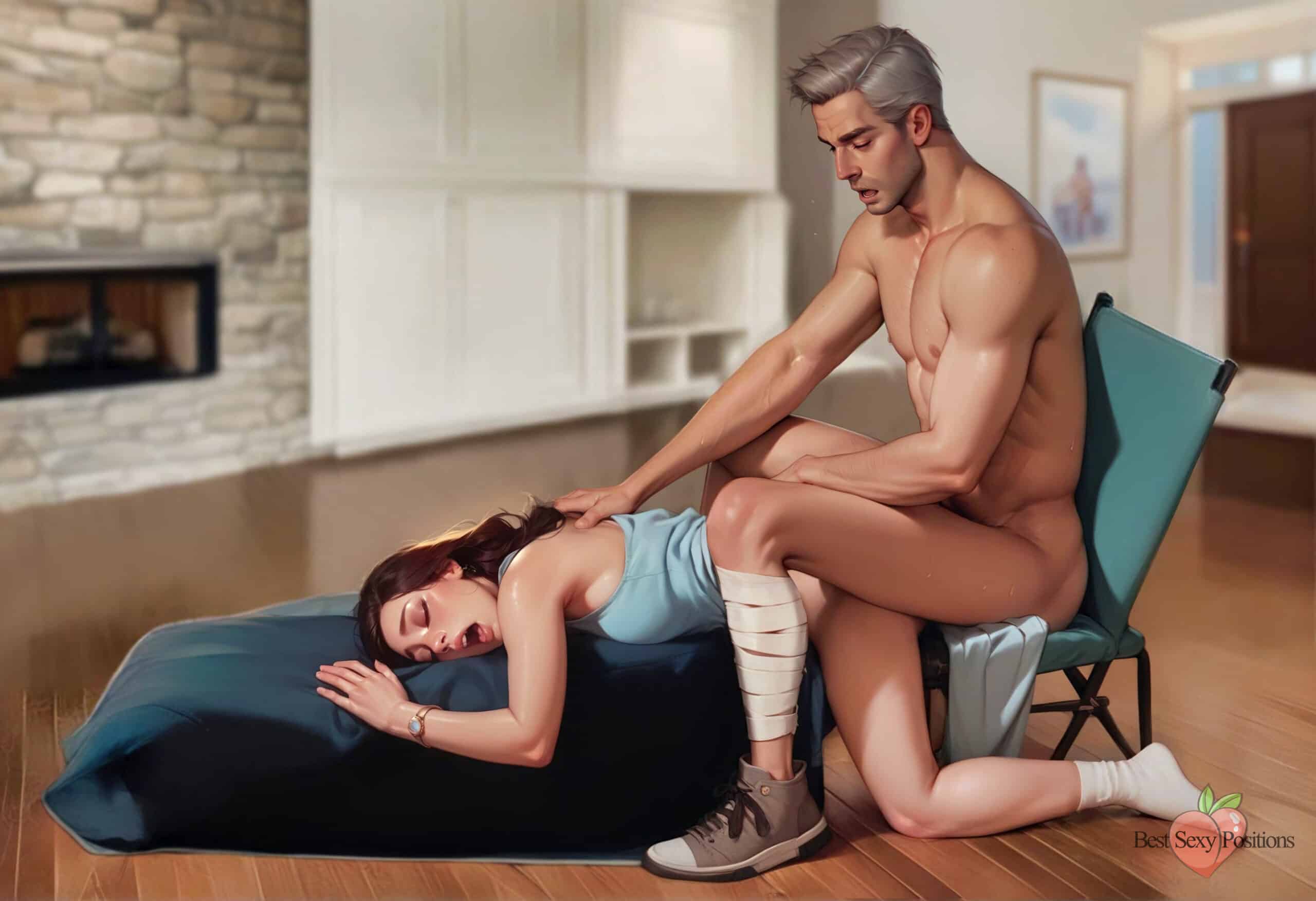
Modified Doggy Style solves a structural problem with standard rear entry: maintaining the quadruped position (hands and knees) requires sustained shoulder, wrist, and core engagement that fatigues quickly with many chronic conditions. The modification is straightforward — the receiving partner leans forward onto a surface (bed edge, table, couch back, stacked pillows) instead of self-supporting. This transfers the mechanical load from muscles to furniture.
Rear-entry geometry provides the deepest penetration of any position in this roundup. The posterior vaginal wall receives the most direct pressure, and the angle of the penetrating partner's pelvis relative to the receiving partner's can be fine-tuned by adjusting the height of the support surface.
Support configurations:
- Bed edge lean: Torso rests forward on the mattress, knees on the floor or a cushion — minimal transfer required
- Wheelchair lean: Receiving partner leans forward over locked chair arms while penetrating partner stands behind
- Wall brace: Both hands on a wall at shoulder height allows a standing modified-doggy variant for those who cannot kneel
Adapting by condition:
- Limited mobility: The forward lean surface holds all torso weight; focus on position setup rather than muscular endurance
- Balance concerns: Wall contact provides two fixed anchor points; the penetrating partner's hands on the receiving partner's hips provide a third
- Height differences: Surface height determines alignment — a step platform or lower furniture adjusts this without requiring either partner to compensate posture
See the full Classic Doggy Style guide.
6. Intimate Lotus / Seated Position

Intimate Lotus is the position that requires the least furniture adaptation for wheelchair users because the chair itself is the support structure. The seated partner (in a wheelchair, sturdy chair, or at the edge of a firm sofa) provides the stable base; the straddling partner climbs on facing them, wrapping their legs around the seated partner's back or resting feet on the chair's foot supports.
The mechanics produce maximum skin-to-skin contact from chest to pelvis, which activates oxytocin and tactile nerve endings simultaneously. Penetration angle in Lotus positions is shallower than rear-entry but allows both partners to contribute pelvic rocking, making it the most genuinely bilateral position in this list.
Why this is particularly well-suited to limited mobility:
- No bed transfer required for wheelchair users
- Both partners' weight is distributed through the chair and/or the straddling partner's legs — neither person needs sustained core engagement to maintain the position
- The close contact provides physical stability: the straddling partner holds the seated partner's shoulders; the seated partner holds the straddling partner's back
Setup:
- Lock wheelchair wheels and remove armrests if the mount will be from the side
- On a standard chair: ensure the chair does not rock or slide (place against a wall or use a non-slip mat)
- Practice the mount once before the encounter so it becomes a natural transition rather than a mechanical interruption
See the full Lotus Position guide.
7. Side-by-Side (Scissors Variant — Pillow Supported)

Both partners lie on their sides with legs intertwined. The receiving partner's top leg rests over the penetrating partner's hip; the penetrating partner angles their pelvis forward to achieve entry. Neither partner bears the other's weight at any point. Because both bodies remain horizontal throughout, this position produces less intrapelvic pressure than any entry-from-above variant.
The trade-off for this gentleness is that active thrusting range is limited by the leg interlock — movement is primarily a rocking or grinding motion rather than full stroke. For chronic pain and fatigue, this is a benefit: sustained grinding creates consistent friction against the anterior or posterior wall (depending on partner orientation) without the muscular effort of full-range thrusting.
Building the comfort setup:
- Body pillows behind each partner keep both from rolling backward
- A pillow between the receiving partner's knees maintains the top leg at a height that does not strain the hip
- Center of bed gives room to adjust interlock without reaching the edge
Pacing note: Side-by-side positions like this are suited to sessions where the goal is sustained arousal rather than rapid escalation. Thirty minutes of consistent grinding is attainable for most people with chronic fatigue; the position does not demand more once set up correctly.
Conditions this suits well:
- Chronic pain — no pressure points anywhere along the spine
- Fibromyalgia or CFS — full-body horizontal support conserves energy
- Post-surgical recovery — confirm clearance with your surgeon or physiotherapist before use, particularly for abdominal or hip procedures
8. Oral Pleasure Positions

Oral positions remove penetration mechanics entirely, which means joint load, reach angle, and fatigue thresholds are all easier to manage. The two most accessible configurations for limited mobility are the side-lying 69 and the supported receiving setup.
Side-by-Side 69

Both partners lie on their sides, heads aligned with each other's genitals. The mutual stimulation distributes active effort between both partners so neither is carrying the full load. Neither partner bears the other's weight. This position can typically be sustained for 20–30 minutes before neck or shoulder fatigue becomes limiting — significantly longer than penetrative positions requiring weight-bearing.
Supported Receiving — Lying Back
The receiving partner lies on their back with pillows under the knees and a folded pillow supporting the head. The giving partner kneels or lies between the receiving partner's legs with their own weight on forearms. Wheelchair users can provide oral stimulation without a bed transfer by positioning the wheelchair at mattress-edge height with the receiving partner lying at the bed's edge.
Technique adaptations for limited dexterity on the giving side:
- Forearm or elbow support on the mattress reduces the duration that neck extensors must hold without rest
- A pillow under the giving partner's chest in a prone-giving position raises the head to a comfortable angle without sustained neck extension
- Rest intervals of 30–60 seconds (switching to hands or a toy) prevent the giving partner's neck fatigue from ending the session prematurely
Adapting for Specific Conditions
Chronic Pain: Timing and Positioning Logic
Harvard Medical School confirms that sexual activity triggers endorphin release — the body's endogenous analgesic system. This means that for many people with chronic pain, the post-sex window involves lower perceived pain than before. The practical implication: schedule intimacy after heat therapy or a warm bath (which relaxes muscles and reduces baseline tension) and during the portion of the day when your medication or condition cycle is at its lowest-pain point.
Positioning logic for pain:
- Positions where all body parts are externally supported (spooning, adaptive missionary with full pillow stack) prevent the compensatory muscle engagement that causes post-session flares
- Avoid positions that require a painful joint to bear load — replace load-bearing with surface support
- Communicate pain level before starting using a shared scale ("I'm at a 3 today — positions where you lead sound right") so your partner can adjust without you needing to break the encounter to renegotiate
When to consult a provider: If pain consistently prevents intimacy or worsens after sex, speak with a physiotherapist specialising in pelvic health or a sexual health provider. Specific interventions — pelvic floor therapy, targeted exercise, device aids, or medication timing adjustments — often resolve what position adaptations alone cannot.
Mobility and Balance Solutions
Multiple support anchors: Any position that gives you wall contact, furniture contact, and partner contact simultaneously reduces the active balance work to near zero. Identify these triple-anchor setups for your space before the session.
Equipment integration: Rollators and walking frames often have a hand-grip height that aligns well with standing-modified-doggy or standing face-to-face entry when positioned in front of the receiving partner. If you're navigating mobility alongside size considerations, sex positions for plus-size bodies covers combined support strategies.
Energy Conservation
Partner-controlled intervals: Agree before starting that you will move between roles at set intervals (e.g., 10 minutes active, rest, repeat). This prevents the default of pushing through fatigue because stopping mid-session feels like failure. Planned transitions are not interruptions.
Quality pacing over duration: A 20-minute session with consistent sensation and no compensatory pain beats a 60-minute session where the last 40 minutes involve increasing discomfort. Positions designed for limited mobility tend to produce more consistent stimulation per unit of effort than positions requiring constant repositioning, which is their core advantage.
Equipment That Makes a Practical Difference
Positioning wedges ($40–80): Purpose-built wedges hold angles that pillow stacks slowly collapse out of over a session. If a pillow elevation works for you, a wedge holds the same angle more reliably for longer.
Easy-grip vibrators and wearable stimulators: These put sensation within reach when hand coordination or grip strength is limited and allow the mobile partner to focus on position maintenance rather than simultaneous manual stimulation.
Remote-controlled toys: A partner can manage a toy's intensity without the user needing to locate, grip, or operate it — particularly useful in positions where both hands are in use for balance.
Investing selectively: Identify the specific challenge each piece of equipment addresses before purchasing. A wedge solves hip-elevation collapse. An easy-grip toy solves dexterity limitations. Buying both without knowing which problem you actually have leads to unused equipment.
If you're working with additional considerations — such as size differences alongside mobility constraints — positions for big penis and positions for small penis both include adapted depth and angle guidance.
Communication That Sustains Intimacy
Before
Frame practical setup as anticipation rather than administration. "My body's working best when you take the lead on movement tonight — I'll direct your angle" sets expectations while signalling what the session will feel like, not just how to arrange pillows.
During
Positional direction given during sex reads as engagement: "support my hip right there," "hold that angle," "take over while I rest" — these communicate need without breaking the encounter's frame.
After
"How is your body feeling?" shows attentiveness and generates the feedback that makes next time better. The positions that work consistently for a specific person and condition are found through iteration, and post-session check-ins are the data source for that iteration.
Bottom Line
Sex positions for limited mobility solve a specific mechanical problem: conventional positions were not designed with diverse mobility profiles in mind, so they impose unnecessary load, range-of-motion requirements, and endurance demands. The eight positions above replace those demands with external support structures — pillows, wedges, furniture, mobility aids, partner positioning — that allow sensation and intimacy to happen without requiring the body to work against its limitations.
The best starting point is the position that addresses your most limiting constraint first. For chronic pain and fatigue, Spooning or Adaptive Missionary with full pillow support reduces active effort to near zero. For wheelchair users, Intimate Lotus or Reverse Cowgirl in the chair eliminates transfer entirely. For those who want to control pacing and depth, Accessible Cowgirl — adapted with a rest position built in — provides that control without requiring sustained endurance.
If pain, injury, or your specific condition creates questions that position adjustment alone does not resolve, a physiotherapist specialising in pelvic health or a sexual health provider is the right next step — they work with these scenarios routinely and can suggest targeted adaptations that generalised guides cannot.
Explore the full sex positions library for additional technique details, or see the complete body-type and accessibility position collection for more adapted guides.